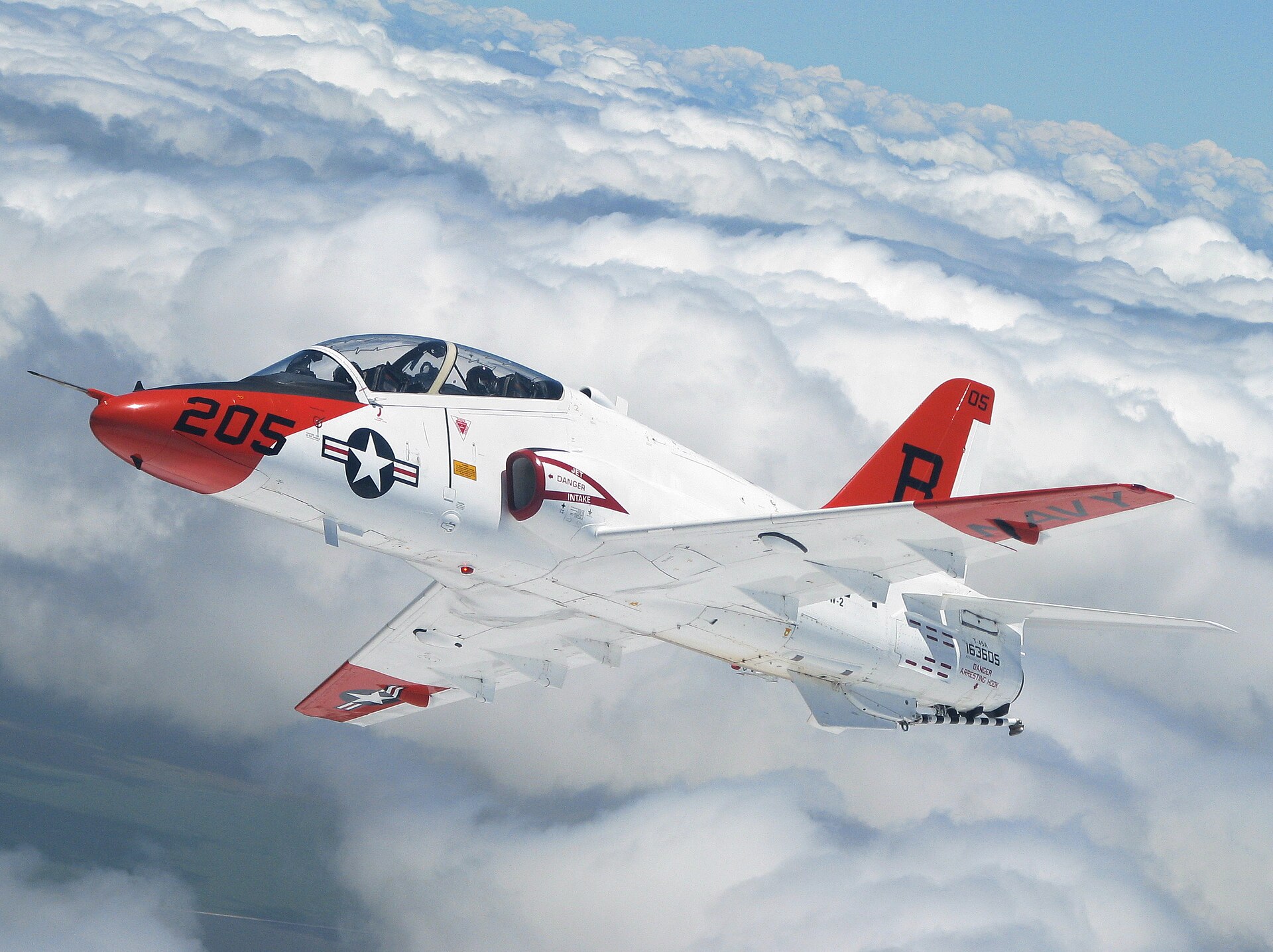
Performance and mechanical data are combined here for a faster, more compact read. Values describe the represented model or nearest clearly identified source variant.
Performance and mechanical specifications for T-45 Goshawk
Primary role
Carrier-capable jet trainer
Crew
2
Configuration
Carrier-capable tandem-seat jet trainer
Powerplant
1 × Rolls-Royce F405 turbofan
Top speed
638 mph
Ceiling
42,500 ft
Published range
805 mi
Length
39 ft 4 in
Wingspan
30 ft 10 in
Max weight
≈14,100 lb
02 · SERVICE CHRONOLOGY
FROM ORIGIN TO LEGACY.
A dated sequence follows the airframe from development through operational use and later evolution. The number of milestones follows the story rather than a fixed template, and each note explains why the event mattered—not only what happened.
ORIGIN
The navalized Goshawk first flew with reinforced landing gear, an arresting hook, and major structural changes from the Hawk. [1]
DEVELOPMENT
The T-45 consolidated intermediate and advanced naval jet training into a single carrier-capable platform. [1]
SERVICE HISTORY
The Goshawk lets students practice carrier approaches before reaching fleet fighters. Periodic structural, oxygen-system, and avionics work shows how a trainer must evolve with both safety knowledge and frontline cockpits. [1]
CONTEXT & LEGACY
Students began carrier qualification in the T-45, unifying advanced jet instruction and arrested-landing preparation in a purpose-built naval trainer. [1]
03 · ARCHIVAL IMAGE
THE AIRFRAME IN CONTEXT.
A documented photograph or archival reference connects the interactive model to a real airframe, operation, or preserved example.
A short, rights-screened motion record adds sound, movement, and operational scale without autoplaying or delaying the interactive model.
T-45 Goshawk carrier operations01:16
A T-45 conducts carrier compatibility flight operations.
REUSE NOTE Embedded without modification. Commercial editorial reuse remains subject to the source record, non-endorsement, trademark, privacy/publicity, and third-party-rights limitations.
The appearance of U.S. Department of War (DoW) visual information does not imply or constitute DoW endorsement.
A short, attributed line restores a human voice to the technical record. Period statements and later recollections are identified by the date label and accompanied by a source link.
“The T-45 is where a student becomes a naval aviator.”
Mark DarrahU.S. Navy rear admiral and aviation program executive
Darrah tied the Goshawk to carrier qualification—the defining transition in the jet-training syllabus.
Focused facts connect the airframe's systems to the way it was built, flown, or used.
01
Navalized design
The Goshawk adapts the British Hawk trainer for U.S. carrier training.
02
Deck hardware
Strengthened landing gear, catapult fittings, an arresting hook, and a revised wing support repeated carrier cycles.
03
Training bridge
Students use the jet to learn formation, instruments, weapons procedures, and carrier approaches.
07 · HISTORICAL FIELD NOTE
WHY IT MATTERS.
The Goshawk combines jet training with strengthened landing gear, an arresting hook, and carrier-approach handling for future naval aviators. It introduces students to high-performance formation, tactical flying, instrument procedures, and the precision required to land a jet on a moving ship. [1]
Reference figures vary by variant, payload, configuration, altitude, test method, and source. Values here are an editorial orientation—not operational or flight-planning data.
Each numbered citation links to an operator, national museum, manufacturer, or established research institution. The scope note tells you exactly what that source supports, and each entry includes its retrieval date.
Where the represented model and source variant differ, the scope is labelled rather than silently treated as an exact match. Read the editorial policy, report a correction through the legal notice, or review 3D-model provenance in the attribution directory.