Performance and mechanical data are combined here for a faster, more compact read. Values describe the represented model or nearest clearly identified source variant.
Performance and mechanical specifications for T-6B Texan II
Primary role
Advanced trainer
Crew
2
Configuration
Tandem-seat turboprop trainer
Powerplant
1 × Pratt & Whitney Canada PT6A-68
Top speed
364 mph
Ceiling
31,000 ft
Published range
1,036 mi
Length
33 ft 4 in
Wingspan
33 ft 5 in
Max weight
≈6,500 lb
02 · SERVICE CHRONOLOGY
FROM ORIGIN TO LEGACY.
A dated sequence follows the airframe from development through operational use and later evolution. The number of milestones follows the story rather than a fixed template, and each note explains why the event mattered—not only what happened.
ORIGIN
The T-6A entered U.S. training service as the common primary platform for Air Force and Navy students. [1]
DEVELOPMENT
The Navy accepted the T-6B with a glass cockpit and advanced avionics to replace the T-34C. [2]
SERVICE HISTORY
The Navy accepted its first T-6B, introducing a digital cockpit and hands-on-throttle-and-stick controls intended to prepare students for more complex fleet aircraft. [1]
CONTEXT & LEGACY
The Navy's glass-cockpit trainer moved students into digital navigation and systems management earlier in the syllabus. Its role is less about combat performance than building habits that transfer to advanced aircraft. [1]
03 · ARCHIVAL IMAGE
THE AIRFRAME IN CONTEXT.
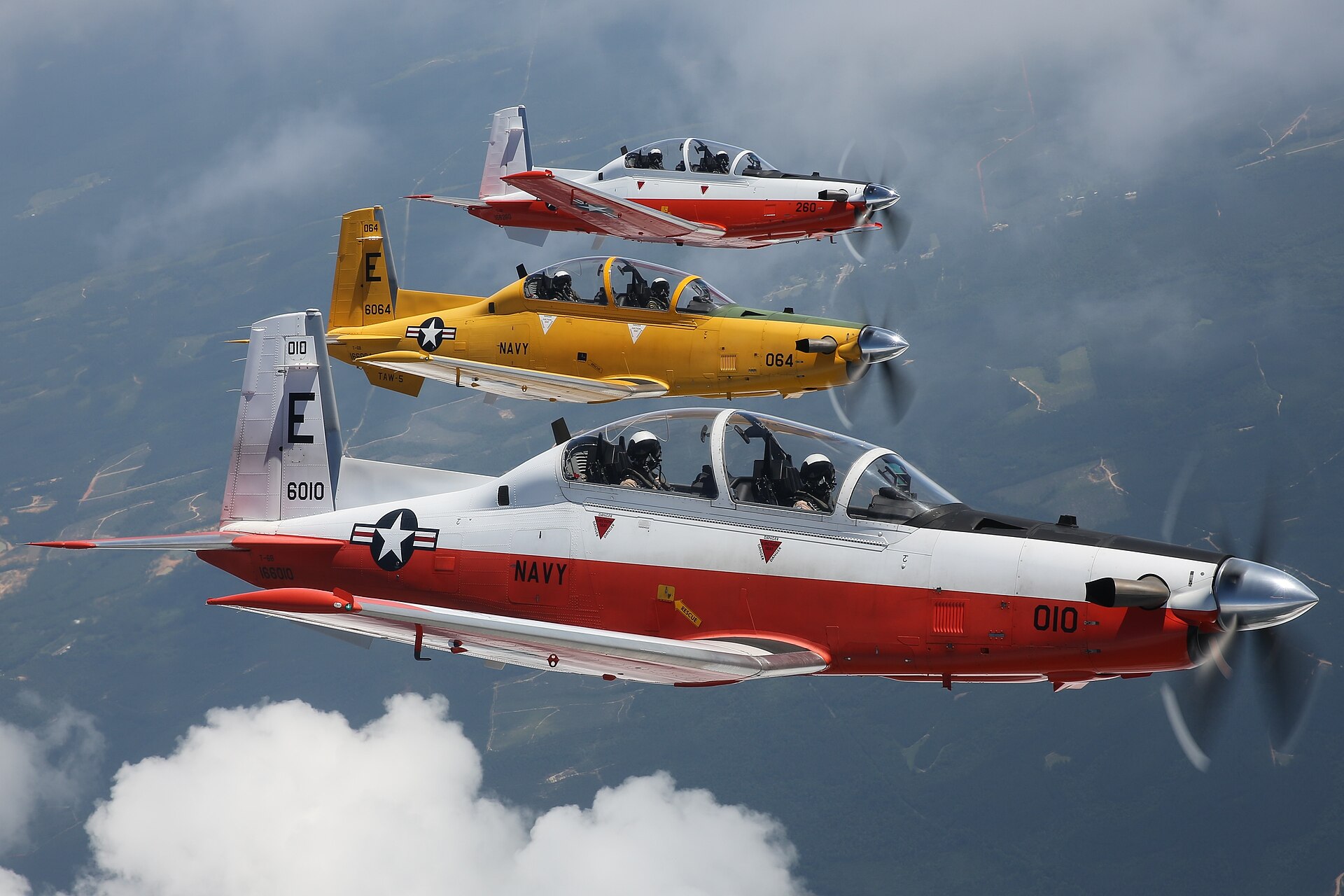
A documented photograph or archival reference connects the interactive model to a real airframe, operation, or preserved example.
US Navy Beechcraft T-6B Texans in flight on 21 June 2016Taken on 21 June 2016 · U.S. Navy photo by Ensign Antonio MoreWikimedia Commons · Public domain · Accessed 29 August 2026VIEW ORIGINAL FILE & RIGHTS RECORD ↗
04 · ARCHIVAL FOOTAGE
THE AIRFRAME IN MOTION.
A short, rights-screened motion record adds sound, movement, and operational scale without autoplaying or delaying the interactive model.
T-6B flight training01:00
Student and instructor pilots conduct training in the exact T-6B variant.
REUSE NOTE Embedded without modification. Commercial editorial reuse remains subject to the source record, non-endorsement, trademark, privacy/publicity, and third-party-rights limitations.
The appearance of U.S. Department of War (DoW) visual information does not imply or constitute DoW endorsement.
A short, attributed line restores a human voice to the technical record. Period statements and later recollections are identified by the date label and accompanied by a source link.
“The T-6B provides a significant aircraft upgrade to the Joint Primary Aircraft Training System.”
J. PatrickU.S. Navy captain and program manager
Patrick emphasized the cockpit and avionics transition represented by the Navy's B model.
Focused facts connect the airframe's systems to the way it was built, flown, or used.
01
Training sequence
The T-6B teaches primary flight skills before students move to advanced jet, maritime, or rotary-wing pipelines.
02
Shared visibility
Stepped tandem seating gives both instructor and student a forward view.
03
Escape system
Martin-Baker ejection seats provide a modern emergency escape capability uncommon in basic trainers.
07 · HISTORICAL FIELD NOTE
WHY IT MATTERS.
The turboprop T-6B prepares naval aviators for advanced aircraft through a high-performance cockpit with modern digital displays and training systems. Its tandem seats, ejection systems, pressurization, and aerobatic capability introduce military procedures and energy management before students move to jets, maritime aircraft, or helicopters. [1][2]
Reference figures vary by variant, payload, configuration, altitude, test method, and source. Values here are an editorial orientation—not operational or flight-planning data.
Each numbered citation links to an operator, national museum, manufacturer, or established research institution. The scope note tells you exactly what that source supports, and each entry includes its retrieval date.
Where the represented model and source variant differ, the scope is labelled rather than silently treated as an exact match. Read the editorial policy, report a correction through the legal notice, or review 3D-model provenance in the attribution directory.