Performance and mechanical data are combined here for a faster, more compact read. Values describe the represented model or nearest clearly identified source variant.
Performance and mechanical specifications for Wright Flyer
Primary role
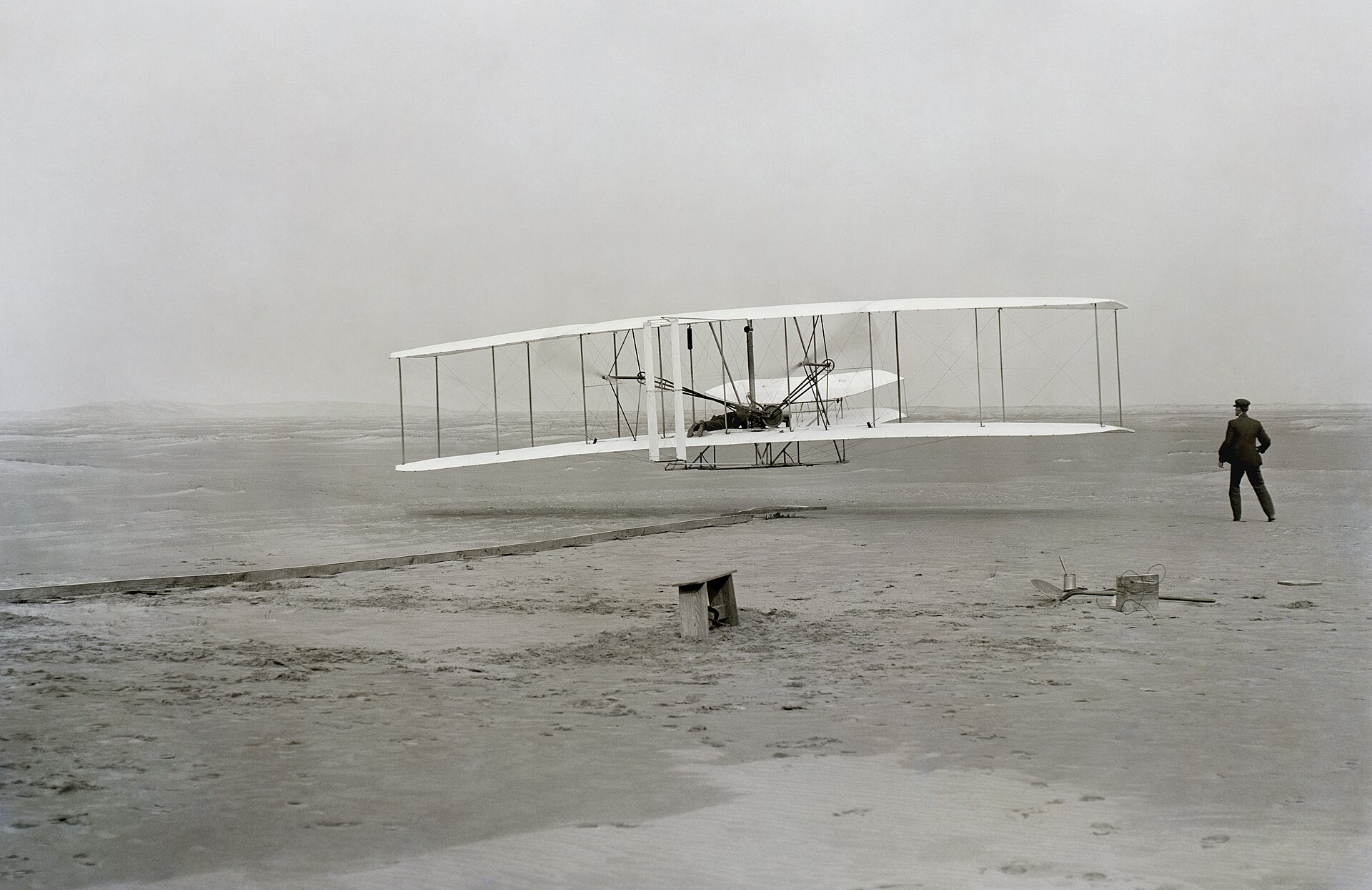
First controlled powered flight
Crew
1 pilot
Configuration
Canard biplane with chain-driven twin propellers
Powerplant
1 × 12 hp four-cylinder engine
Top speed
30 mph
Ceiling
10 ft
Published range
852 ft
Length
21 ft 1 in
Wingspan
40 ft 4 in
Weight
≈605 lb
02 · SERVICE CHRONOLOGY
FROM ORIGIN TO LEGACY.
A dated sequence follows the airframe from development through operational use and later evolution. The number of milestones follows the story rather than a fixed template, and each note explains why the event mattered—not only what happened.
ORIGIN
Three seasons of glider experiments let the Wrights refine lift data and develop three-axis control before adding power. [1]
DEVELOPMENT
Four flights at Kill Devil Hills culminated in a 59-second, 852-foot flight before wind damaged the aircraft. [1]
SERVICE HISTORY
The 1903 Flyer proved controlled powered flight, but the Wrights' later Flyers made repeated turns and practical circuits. The achievement became a usable flying system through continued testing, not one isolated hop. [1]
CONTEXT & LEGACY
Public demonstrations in France and the United States made the Wrights' controlled turns and sustained flight visible to a wide audience, transforming acceptance of their earlier claims. [1]
03 · ARCHIVAL IMAGE
THE AIRFRAME IN CONTEXT.
A documented photograph or archival reference connects the interactive model to a real airframe, operation, or preserved example.
A short, rights-screened motion record adds sound, movement, and operational scale without autoplaying or delaying the interactive model.
Wright Brothers Day00:50
An official short-form history of the Wright Flyer's first powered flights; visuals may include reproductions and still records.
VARIANT NOTE Related-family footage is identified here and is not presented as the exact modeled variant.
REUSE NOTE Embedded without modification. Commercial editorial reuse remains subject to the source record, non-endorsement, trademark, privacy/publicity, and third-party-rights limitations.
The appearance of U.S. Department of War (DoW) visual information does not imply or constitute DoW endorsement.
A short, attributed line restores a human voice to the technical record. Period statements and later recollections are identified by the date label and accompanied by a source link.
“Success four flights Thursday morning all against twenty one mile wind.”
Orville WrightPilot and co-inventor
Orville's telegram home reported the four flights in practical, measured language immediately after the event.
Focused facts connect the airframe's systems to the way it was built, flown, or used.
01
Propeller research
The Wrights treated propellers as rotating wings and designed their own efficient pair.
02
Chain drive
A single engine drove two counter-rotating pusher propellers through bicycle-style chains.
03
Measured design
Wind-tunnel tests corrected unreliable published lift data and informed the Flyer’s wing.
07 · HISTORICAL FIELD NOTE
WHY IT MATTERS.
On 17 December 1903, the Wright Flyer made the first sustained, controlled flight by a powered, heavier-than-air machine. Its wing-warping controls, forward elevator, and carefully tested airfoils turned flight from a brief leap into a repeatable act of piloting, even though the aircraft remained unstable and demanding to fly. [1]
Reference figures vary by variant, payload, configuration, altitude, test method, and source. Values here are an editorial orientation—not operational or flight-planning data.
Each numbered citation links to an operator, national museum, manufacturer, or established research institution. The scope note tells you exactly what that source supports, and each entry includes its retrieval date.
Where the represented model and source variant differ, the scope is labelled rather than silently treated as an exact match. Read the editorial policy, report a correction through the legal notice, or review 3D-model provenance in the attribution directory.