Performance and mechanical data are combined here for a faster, more compact read. Values describe the represented model or nearest clearly identified source variant.
Performance and mechanical specifications for YA-10B Warthog
Primary role
Two-seat attack prototype
Crew
2
Configuration
Tandem-seat night-attack prototype
Powerplant
2 × General Electric TF34 turbofans
Top speed
439 mph
Ceiling
45,000 ft
Published range
2,580 mi
Length
≈53 ft
Wingspan
57 ft 6 in
Max weight
≈50,000 lb
02 · SERVICE CHRONOLOGY
FROM ORIGIN TO LEGACY.
A dated sequence follows the airframe from development through operational use and later evolution. The number of milestones follows the story rather than a fixed template, and each note explains why the event mattered—not only what happened.
ORIGIN
A production A-10A was converted with a raised rear cockpit for the night/adverse-weather demonstrator program. [1]
DEVELOPMENT
The sole two-seat demonstrator tested whether a second crewmember and additional sensors could improve night attack. Its cancellation left a useful case study in capability gained versus weight, cost, and fleet complexity. [1]
SERVICE HISTORY
The converted two-seat prototype made its first flight with a second cockpit and enlarged tail, beginning an evaluation of night and adverse-weather attack concepts. [1]
CONTEXT & LEGACY
Flight testing proved the two-seat concept, but the Air Force did not place the specialized version into production. [1]
03 · ARCHIVAL IMAGE
THE AIRFRAME IN CONTEXT.
A documented photograph or archival reference connects the interactive model to a real airframe, operation, or preserved example.
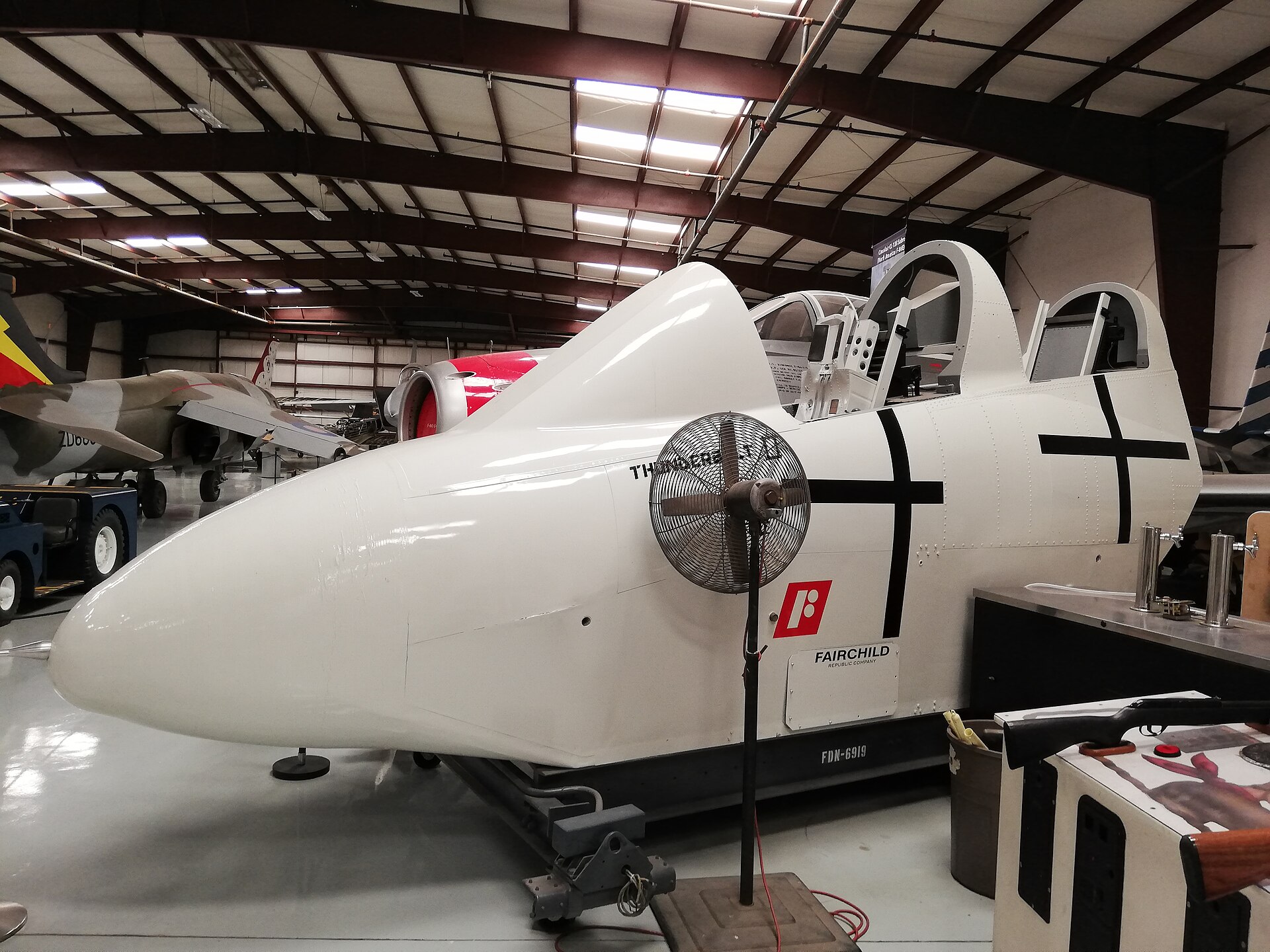
Fairchild YA-10B Thunderbolt II Rocket Sled (25749369740)2019-09-20 10:48:46 · 先従隗始Wikimedia Commons · CC0 · Accessed 29 August 2026VIEW ORIGINAL FILE & RIGHTS RECORD ↗
04 · ARCHIVAL FOOTAGE
THE AIRFRAME IN MOTION.
A short, rights-screened motion record adds sound, movement, and operational scale without autoplaying or delaying the interactive model.
Airframe: A-10 Thunderbolt II02:14
Related-airframe footage of the production single-seat A-10. The archive record covers the unique two-seat YA-10B prototype.
VARIANT NOTE Related-family footage is identified here and is not presented as the exact modeled variant.
REUSE NOTE Embedded without modification. Commercial editorial reuse remains subject to the source record, non-endorsement, trademark, privacy/publicity, and third-party-rights limitations.
The appearance of U.S. Department of War (DoW) visual information does not imply or constitute DoW endorsement.
A short, attributed line restores a human voice to the technical record. Period statements and later recollections are identified by the date label and accompanied by a source link.
“It was a very stable gun platform and easy to fly.”
Charles SewellFairchild Republic test pilot
Sewell's assessment describes the two-seat demonstrator as an A-10 first and a sensor experiment second.
Focused facts connect the airframe's systems to the way it was built, flown, or used.
01
Single conversion
Only one two-seat Night/Adverse Weather demonstrator was produced from an existing A-10 airframe.
02
Raised instructor
The rear cockpit sat higher to preserve forward visibility over the front seat.
03
Night concept
A sensor pod and second crew member were intended to improve low-level attack in darkness and poor weather.
07 · HISTORICAL FIELD NOTE
WHY IT MATTERS.
This rare two-seat A-10 prototype explored an all-weather attack and training configuration without entering production. A second cockpit and expanded avionics changed the familiar Warthog profile, showing how the durable close-air-support platform might have divided navigation, sensor, and weapons tasks between two crew members. [1]
Reference figures vary by variant, payload, configuration, altitude, test method, and source. Values here are an editorial orientation—not operational or flight-planning data.
Each numbered citation links to an operator, national museum, manufacturer, or established research institution. The scope note tells you exactly what that source supports, and each entry includes its retrieval date.
Where the represented model and source variant differ, the scope is labelled rather than silently treated as an exact match. Read the editorial policy, report a correction through the legal notice, or review 3D-model provenance in the attribution directory.