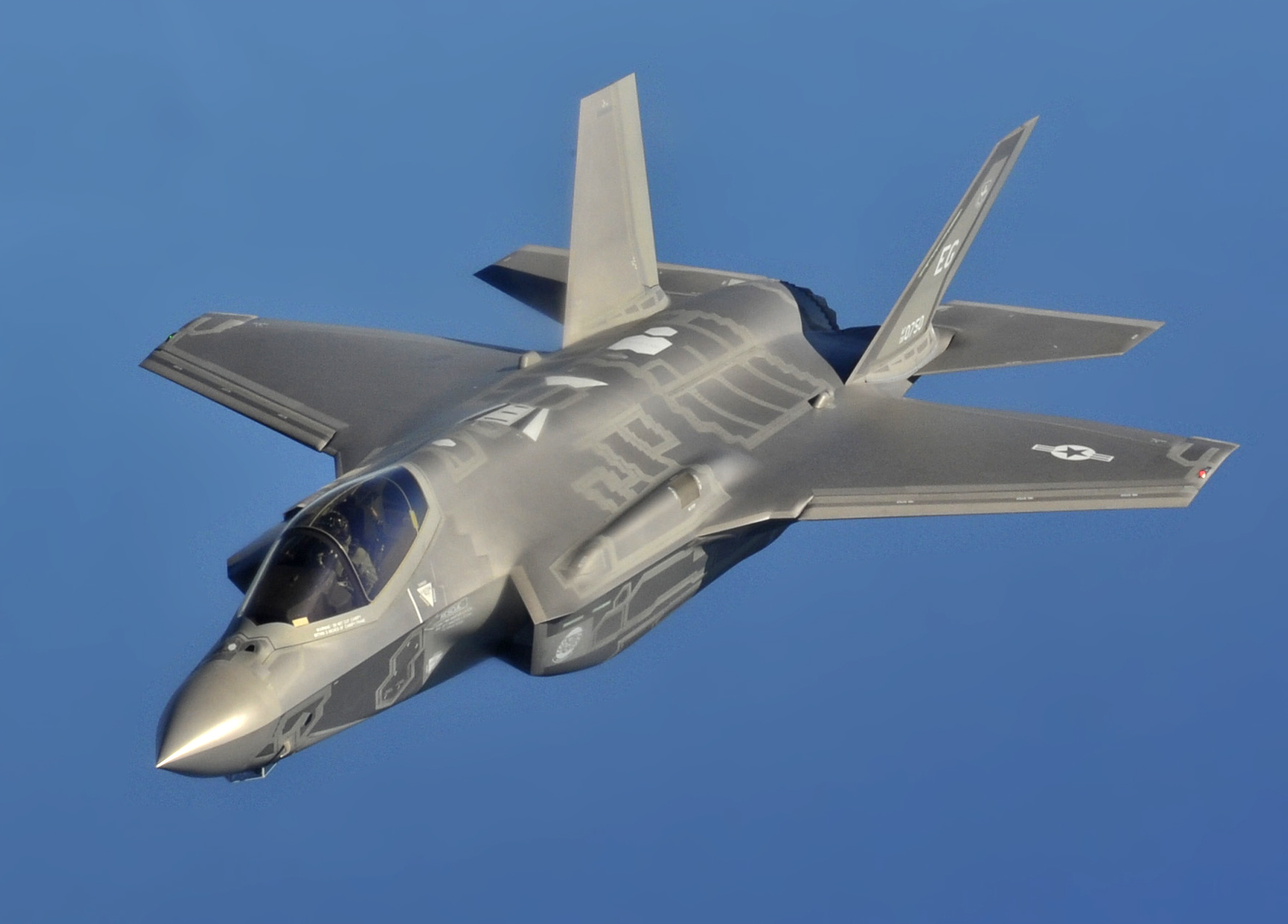
Performance and mechanical data are combined here for a faster, more compact read. Values describe the represented model or nearest clearly identified source variant.
Performance and mechanical specifications for F-35A Lightning II
A dated sequence follows the airframe from development through operational use and later evolution. The number of milestones follows the story rather than a fixed template, and each note explains why the event mattered—not only what happened.
ORIGIN
The X-35 demonstrator flew during the Joint Strike Fighter competition that preceded the production design. [1]
DEVELOPMENT
The U.S. Air Force declared the F-35A initially operational with its first combat-coded squadron. [1]
SERVICE HISTORY
Software blocks, weapons clearances, and mission-data updates have expanded the F-35A after initial service entry. Its combat value depends on sensor fusion and network support as much as on the visible airframe. [1]
CONTEXT & LEGACY
Israeli F-35Is became the first aircraft in the wider F-35 family publicly acknowledged as having flown combat operations, an early operational test of the platform's sensor-led concept. [1]
03 · ARCHIVAL IMAGE
THE AIRFRAME IN CONTEXT.
A documented photograph or archival reference connects the interactive model to a real airframe, operation, or preserved example.
A short, rights-screened motion record adds sound, movement, and operational scale without autoplaying or delaying the interactive model.
F-35A flight operations at Kadena00:20
F-35A aircraft of the 158th Fighter Wing conduct flight operations.
REUSE NOTE Embedded without modification. Commercial editorial reuse remains subject to the source record, non-endorsement, trademark, privacy/publicity, and third-party-rights limitations.
The appearance of U.S. Department of War (DoW) visual information does not imply or constitute DoW endorsement.
A short, attributed line restores a human voice to the technical record. Period statements and later recollections are identified by the date label and accompanied by a source link.
“Every day I kind of pinch myself when I realize this is my job.”
Christine MauU.S. Air Force lieutenant colonel and F-35A pilot
Mau reflected on flying the F-35A after becoming the first woman to pilot the type.
Focused facts connect the airframe's systems to the way it was built, flown, or used.
01
Sensor fusion
Radar, electro-optical, infrared, and off-board information are combined into a single pilot display.
02
Spherical awareness
Six infrared cameras in the Distributed Aperture System provide broad coverage around the aircraft.
03
Internal carriage
Weapons bays preserve low-observable performance; external stations add capacity when stealth is less critical.
07 · HISTORICAL FIELD NOTE
WHY IT MATTERS.
The conventional-runway F-35A combines low-observable shaping, sensor fusion, and internal weapons carriage with the lightest airframe and largest internal fuel load of the three F-35 variants. It entered U.S. Air Force operational service in 2016 and is designed for both air-to-air and precision-strike missions. [1]
Reference figures vary by variant, payload, configuration, altitude, test method, and source. Values here are an editorial orientation—not operational or flight-planning data.
Each numbered citation links to an operator, national museum, manufacturer, or established research institution. The scope note tells you exactly what that source supports, and each entry includes its retrieval date.
Where the represented model and source variant differ, the scope is labelled rather than silently treated as an exact match. Read the editorial policy, report a correction through the legal notice, or review 3D-model provenance in the attribution directory.