Performance and mechanical data are combined here for a faster, more compact read. Values describe the represented model or nearest clearly identified source variant.
Performance and mechanical specifications for North American XB-70 Valkyrie
Primary role
Supersonic bomber research aircraft
Crew
2
Configuration
Mach 3 canard-delta research aircraft
Powerplant
6 × General Electric YJ93 turbojets
Top speed
Mach 3.08
Ceiling
77,350 ft
Published range
4,288 mi
Length
185 ft 10 in
Wingspan / rotor
105 ft, tips raised
Weight
≈542,000 lb maximum
02 · SERVICE CHRONOLOGY
FROM ORIGIN TO LEGACY.
A dated sequence follows the airframe from development through operational use and later evolution. The number of milestones follows the story rather than a fixed template, and each note explains why the event mattered—not only what happened.
ORIGIN
The Air Force sought a Mach 3 high-altitude strategic bomber. [1]
DEVELOPMENT
XB-70A number one first flew as the program shifted toward research. [1]
SERVICE HISTORY
The Valkyrie exceeded Mach 3 and explored compression lift. [1]
SERVICE HISTORY
A formation-flight collision destroyed the second aircraft. [1]
CONTEXT & LEGACY
The survivor completed its final flight and entered museum preservation. [1]
03 · ARCHIVAL IMAGE
THE AIRFRAME IN CONTEXT.
A documented photograph or archival reference connects the interactive model to a real airframe, operation, or preserved example.
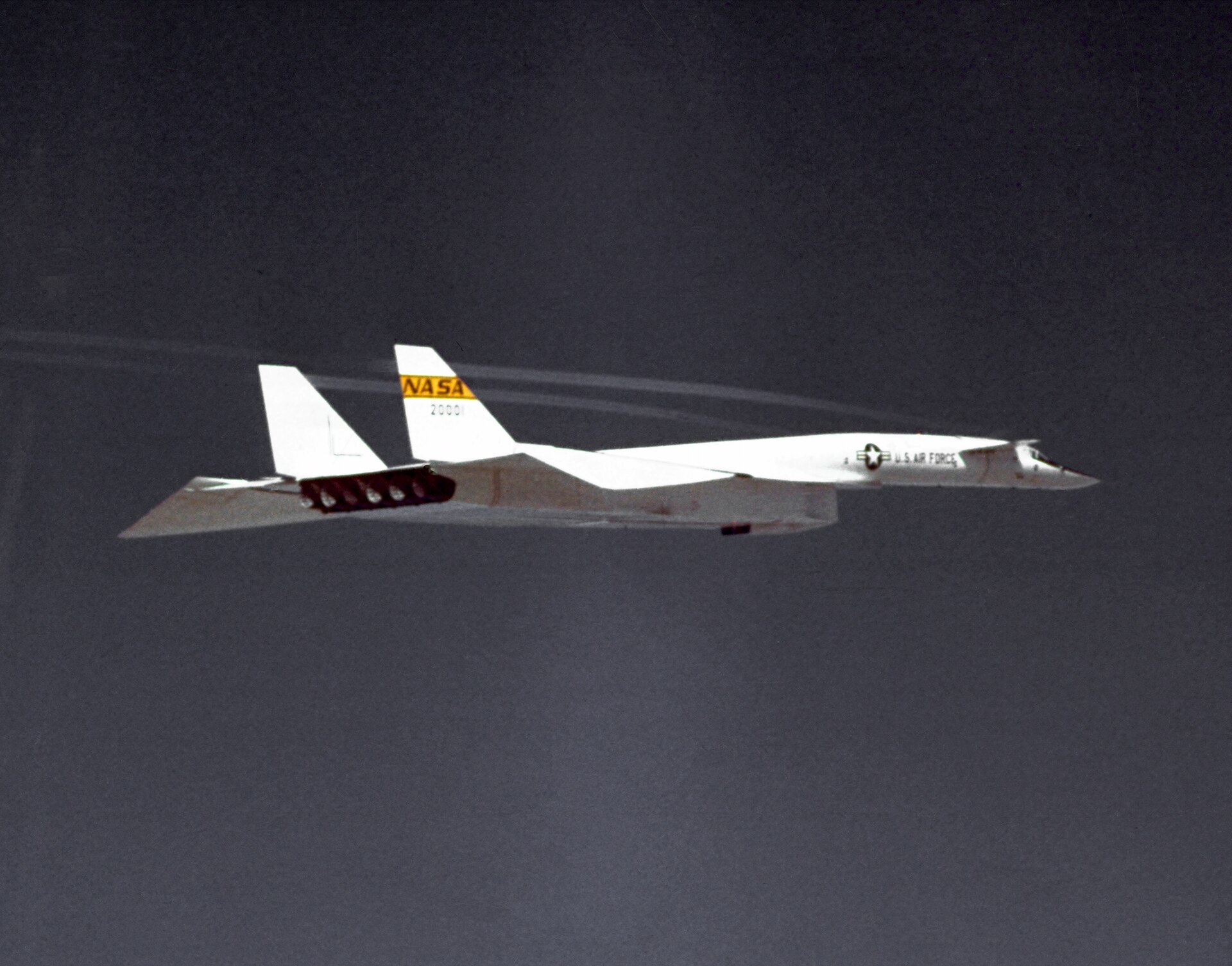
Built to explore sustained Mach 3 flight at bomber scale, the XB-70 used six engines, a slender forward fuselage, folding wingtips, and compression lift beneath its delta wing. Only two were completed, but their flights produced valuable data on heating, structures, handling, and high-speed aerodynamics. [1]
Reference figures vary by variant, payload, configuration, altitude, test method, and source. Values here are an editorial orientation—not operational or flight-planning data.
Each numbered citation links to an operator, national museum, manufacturer, or established research institution. The scope note tells you exactly what that source supports, and each entry includes its retrieval date.
Where the represented model and source variant differ, the scope is labelled rather than silently treated as an exact match. Read the editorial policy, report a correction through the legal notice, or review 3D-model provenance in the attribution directory.